
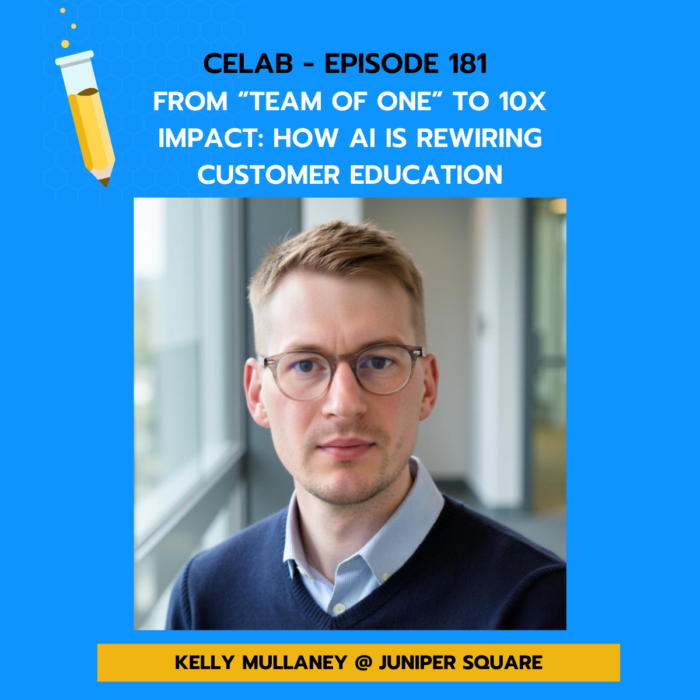
In this episode of the Customer Education Lab, Adam Avramescu sits down with Kelly Mullaney, Head of AI Guild at Juniper Square, to unpack how AI is actually changing Customer Education. Kelly traces his journey from tax tech writer at Microsoft, to leading Customer Education at Envestnet, to building AI Guild—an internal enablement function focused on helping teams 10x their productivity with AI. Along the way, he shares concrete builds: an AI‑driven help center that watches code commits and auto‑drafts release notes and docs, a 37‑agent competitive intelligence system feeding Slack, and experiments in “vibe‑coded” e‑learning that challenge what LMSs and SCORM should look like in an AI‑first world.
Adam and Kelly go deep on the questions every Customer Education and Customer Success leader is wrestling with: Will AI kill our jobs, or amplify our impact? When does it make sense to build with AI versus buy another SaaS tool? How can small, scrappy teams of one keep up when engineering output increases 10x? You’ll hear a practical breakdown of the Anthropic stack (Claude Chat, Code Desktop, Cowork, Design, Managed Agents), a simple “80% AI / 20% human‑in‑the‑loop” mental model, and a candid look at the future of help centers, LMSs, and documentation. If you’re trying to move past the hype and see what AI‑enabled customer education really looks like, this episode is for you.
We talk about:
- AI as the new “electricity”: why simply bolting AI onto old workflows fails—and what it means to rewire your education stack.
- Kelly’s path: tech writer → running Customer Education at a $5B company → leading AI Guild at Juniper Square.
- Human‑in‑the‑loop: using AI to get to 80% done and relying on experts for the final 20% quality bar.
- AI‑driven help centers: monitoring Git repos for meaningful commits, pulling Jira context, applying style guides, and auto‑drafting release notes and help docs.
- Fixed docs vs. AI assistants: why Kelly layers AI chat on top of a traditional help center instead of replacing it outright.
- Discovering content gaps: using AI search and chat logs to identify missing documentation and new questions customers are asking.
- Build vs. buy math: when building 80% of a SaaS tool in a weekend (with Claude + Supabase + agents) beats paying $30–60K per year.
- Agentic competitive intel: 37 Claude agents monitor competitors, post daily briefs to Slack, and learn from a feedback loop.
- Rethinking LMS and SCORM: legacy tools’ reporting limitations vs. what AI‑enabled tracking and analysis can unlock.
- Demystifying Anthropic’s stack: how Claude Chat, Code, Cowork, Design, MCPs/connectors, and Managed Agents fit together.
- Tool choice vs. governance: innovating even when your company only “allows” one AI vendor like Copilot.
- Why CE leaders are primed for AI: curiosity, user empathy, and great questions matter more than coding backgrounds.
- Getting started advice: don’t just “insert AI into the SDLC”—reimagine your education model for a 10x‑faster product team.