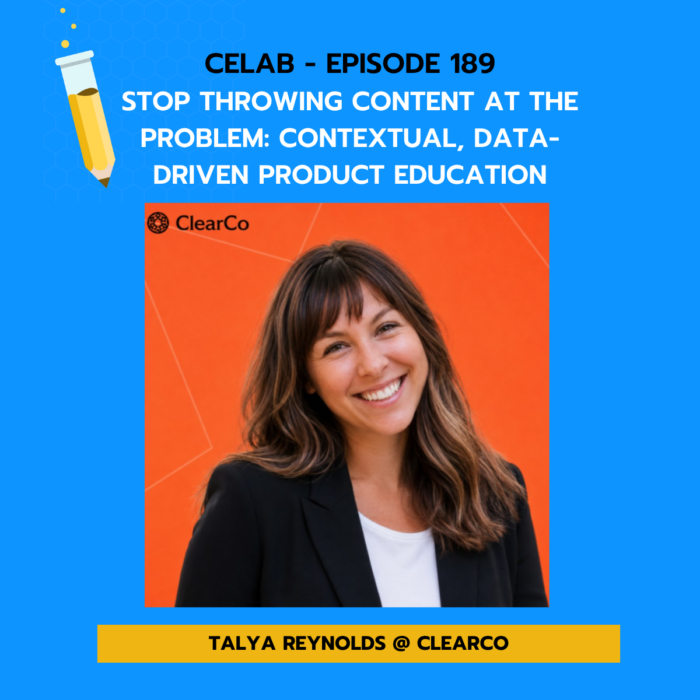
Producing customer education content has never been cheaper, and that’s exactly why making more of it is no longer the answer. The teams pulling ahead are the ones making smarter decisions about what to build, when to show it, and where it should live. In this episode, Adam sits down with Talya Reynolds, Head of Product Education at ClearCo. Nearly ten years ago, Talya found the name for the work she was already doing by listening to CELab. Today she’s rebuilding product education as a data-driven system designed to teach customers in the moment, inside the product, instead of sending them off to a course.
Talya gets refreshingly specific about what that system takes. She covers when contextual education works and when screen real estate means a deeper format is still the right call. She explains why ClearCo is building a user maturity score from entitlement, product telemetry, support tickets, and call sentiment instead of trusting usage alone. She describes how her team is consolidating Gong, Zendesk, product data, and Slack into a customer hub, and how skills in a shared GitHub repo are starting to turn PRDs into first-draft docs and learning plans. She’s just as candid about the costs, the human review that self-healing content still needs, and the two months her team lost chasing a perfect AI model. If you work in Customer Education or Customer Success, this is a practical blueprint for contextual learning. If you’re in Digital CS, Product Marketing, Enablement, Support, or L&D, it’s a clear look at how shared customer data can make every team’s content smarter.
Highlights from this episode:
- Stop sending users to a course. Why “take a course to learn our guides” is a bad signal for any product, and what changed when Talya moved repeat questions into the app.
- Usage isn’t health. A busy account can still be an unhappy one. Here’s how a user maturity score triangulates entitlement, telemetry, and sentiment.
- Docs drafted from the code. Skills, schemas, and governance rules in a GitHub repo that produce first-draft documentation, adoption plans, and learning plans.
- Self-healing content has a price tag. How a tiering calculator decides when the update agent runs, and why a minor UI tweak can break 50 embedded guides.
- Write for humans and LLMs at once. Governance, alt text, heading order, task-based jobs-to-be-done articles, and the table problem nobody has solved yet.
Connect with Talya on LinkedIn; she welcomes DMs and ideas on cracking the content intelligence model.