
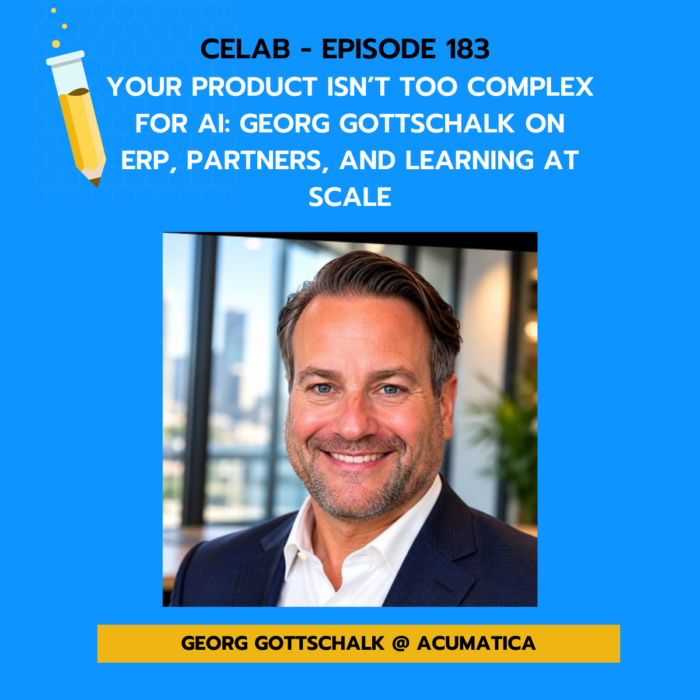
In this episode of the Customer Education Lab, Georg Gottschalk, VP of Global Education at Acumatica, to unpack what it really takes to build a skill infrastructure around a highly complex ERP platform. Georg traces his journey from early work with SAP and manufacturing optimization, through leadership roles at IBM, Salesforce, and MuleSoft, to his current mandate: Enabling a fast-growing, partner-led ecosystem in the small and mid-sized business ERP space. Georg shares why ERP is one of the ultimate “stress tests” for Customer Education and why the old excuse of “our product is too complex for AI” no longer holds up.
The conversation dives deep into AI-assisted learning, micro-vertical partner strategies, and what it means to certify companies instead of just individuals. Georg explains how Acumatica leverages tools like LearnExperts’ LEAi to transform rich but dense documentation into fun, engaging, and increasingly personalized education at scale—without tripling headcount. You’ll hear how his team thinks about partner enablement, customer onboarding that massively exceeded adoption targets, weaving education into the product workflow, and even “teaching machines” by producing content optimized for LLMs. If you work in Customer Education or Customer Success and are wrestling with complexity, scale, or AI, this is an episode you won’t want to miss.
Here are some of the key insights from this episode!
- AI works for complex products too — the “too technical for AI” excuse no longer holds; AI acts as a force multiplier, handling grunt work (first-pass quizzes, structuring, transformations) so SMEs can focus on quality.
- Skill infrastructure at ecosystem scale — enabling customers, partners, consultants, and developers across a complex ERP, with tools like Leah powering engaging, personalized education.
- Certifying companies, not just individuals — partner-level certification builds trust and signals capability, supporting a partner-led growth and micro-vertical strategy.
- Closing the value gap — bridging what the platform can do and what users actually achieve through in-workflow, contextual guidance rather than course-based learning alone.
- Hyper-personalization with telemetry — using product usage data to spot skill gaps and deliver “what users need tomorrow, not today.”
- Teaching machines and fostering experimentation — writing content readable by LLMs and skill files for AI agents, while leaders create psychological safety for teams to experiment, keeping humans in the loop.